of a page * * Attributes (all on the contents element except where noted): * wa-toc-element="contents" | "link" | "table" | "ix-trigger" * -- structural markers. Multiple * "table" elements are allowed * and each receives a TOC copy. * wa-toc-offsettop="" -- click-scroll offset only * (e.g. clear a fixed navbar) * wa-toc-offsetbottom="" -- shifts active line down * wa-toc-activeline="" -- where headings activate * during scroll. Default 33vh. * wa-toc-headings="" -- restrict which heading levels * are collected. Default h2..h6. * wa-toc-hideurlhash="true" -- suppress #hash on click * wa-toc-ancestoractive="true" -- mark ancestors active too * wa-toc-instance="" -- (on a shared parent) scopes * multiple TOCs on one page * * In-text directives (inside heading plain text, stripped at render): * [wa-toc-omit] -- exclude this heading * [wa-toc-h2] .. [wa-toc-h6] -- override heading level in * the TOC only * * Active state uses Webflow's native `.w--current` class so styling can be * configured directly in the Webflow Designer. */ (function () { 'use strict'; var ACTIVE_CLASS = 'w--current'; var ATTR = 'wa-toc-element'; var DIRECTIVE_RE = /\[wa-toc-(omit|h([2-6]))\]/i; var DEFAULT_HEADING_SELECTOR = 'h2, h3, h4, h5, h6'; // ---------- utilities -------------------------------------------------- /** * Slugify heading text into an id. Mirrors Webflow's native id generation * closely enough for hash navigation: lowercase, spaces 鈫 hyphens, drop * non-alphanumeric except hyphens, collapse runs of hyphens. */ function slugify(text) { return String(text) .toLowerCase() .trim() .replace(/[\s_]+/g, '-') .replace(/[^a-z0-9\-]/g, '') .replace(/-+/g, '-') .replace(/^-|-$/g, ''); } /** Ensure a slug is unique within a Set, suffixing -2, -3, ... if needed. */ function uniqueSlug(base, used) { if (!base) base = 'section'; var slug = base; var i = 2; while (used.has(slug)) { slug = base + '-' + i++; } used.add(slug); return slug; } /** * Convert a CSS length string (e.g. "8rem", "120px", "10vh") to pixels, * resolved against the document root. Returns 0 on failure. */ function cssLengthToPx(value) { if (!value) return 0; var probe = document.createElement('div'); probe.style.position = 'absolute'; probe.style.visibility = 'hidden'; probe.style.height = value; probe.style.width = '0'; document.body.appendChild(probe); var px = probe.getBoundingClientRect().height; document.body.removeChild(probe); return isFinite(px) ? px : 0; } /** * Parse the wa-toc-headings attribute into a CSS selector. Accepts: * "h2,h3" 鈫 "h2, h3" * "h2 h3 h4" 鈫 "h2, h3, h4" * "2,3" 鈫 "h2, h3" * "H2, h3" 鈫 "h2, h3" (case-insensitive) * Tokens outside h2..h6 are dropped. Returns the default selector when * the input is empty or yields no valid levels 鈥 keeps behavior safe. */ function parseHeadingLevels(raw) { if (!raw) return DEFAULT_HEADING_SELECTOR; var tokens = String(raw) .toLowerCase() .split(/[\s,]+/); var levels = []; var seen = {}; for (var i = 0; i < tokens.length; i++) { var tok = tokens[i].trim(); if (!tok) continue; // Accept "h2" or "2". var m = /^h?([2-6])$/.exec(tok); if (!m) continue; var tag = 'h' + m[1]; if (seen[tag]) continue; seen[tag] = true; levels.push(tag); } if (!levels.length) return DEFAULT_HEADING_SELECTOR; return levels.join(', '); } /** Find the closest ancestor (or self) carrying wa-toc-instance. */ function instanceOf(el) { var node = el; while (node && node.nodeType === 1) { if (node.hasAttribute('wa-toc-instance')) { return node.getAttribute('wa-toc-instance'); } node = node.parentElement; } return ''; // default unnamed instance } /** Find the link template within a given root, matching wa-toc-element="link". */ function findLinkTemplate(root) { return root.querySelector('[' + ATTR + '="link"]'); } /** * The link template may be applied directly to an , or to a text * element nested inside an . Resolve to the actual we should clone. */ function resolveAnchorTemplate(linkEl) { if (linkEl.tagName === 'A') return linkEl; var anchor = linkEl.closest('a'); return anchor || linkEl; // fall back to the marked element itself } /** * Within a cloned link, find the text-bearing element that originally had * wa-toc-element="link". If the marker was on the anchor itself, the * anchor is the text holder. */ function findTextHolder(clonedAnchor, originalMarker) { if (originalMarker.tagName === 'A') return clonedAnchor; // The marker was a descendant; find the same descendant in the clone by // walking the same path. var path = []; var node = originalMarker; var rootAnchor = originalMarker.closest('a'); while (node && node !== rootAnchor) { var parent = node.parentElement; if (!parent) break; path.unshift(Array.prototype.indexOf.call(parent.children, node)); node = parent; } var current = clonedAnchor; for (var i = 0; i < path.length; i++) { current = current.children[path[i]]; if (!current) return clonedAnchor; } return current; } // ---------- per-instance pipeline ------------------------------------- function buildInstance(contentsEl) { var instanceId = instanceOf(contentsEl); // Locate the link template in the same instance. var linkMarker = null; var allLinks = document.querySelectorAll('[' + ATTR + '="link"]'); for (var i = 0; i < allLinks.length; i++) { if (instanceOf(allLinks[i]) === instanceId) { linkMarker = allLinks[i]; break; } } if (!linkMarker) return null; // nothing to do var anchorTemplate = resolveAnchorTemplate(linkMarker); // Locate every wa-toc-element="table" in the same instance. The TOC will // be rendered into each one 鈥 same headings, same active-state tracking, // independent styling contexts. If none are present, fall back to a // single mount at the link template's parent (Finsweet-compatible). var mountEls = []; var allTables = document.querySelectorAll('[' + ATTR + '="table"]'); for (var j = 0; j < allTables.length; j++) { if (instanceOf(allTables[j]) === instanceId) { mountEls.push(allTables[j]); } } if (!mountEls.length) { var fallback = anchorTemplate.parentElement; if (!fallback) return null; mountEls.push(fallback); } // Read config off the contents element. var offsetTopVal = cssLengthToPx(contentsEl.getAttribute('wa-toc-offsettop')); var offsetBotVal = cssLengthToPx(contentsEl.getAttribute('wa-toc-offsetbottom')); var hideHash = contentsEl.getAttribute('wa-toc-hideurlhash') === 'true'; var ancestorMode = contentsEl.getAttribute('wa-toc-ancestoractive') === 'true'; var activeLineAttr = contentsEl.getAttribute('wa-toc-activeline'); var activeLineRaw = activeLineAttr; // keep raw for vh re-resolution on resize var headingSelector = parseHeadingLevels(contentsEl.getAttribute('wa-toc-headings')); // Collect heading elements in document order, applying directives. var rawHeadings = contentsEl.querySelectorAll(headingSelector); var headings = []; var usedIds = new Set(); for (var k = 0; k < rawHeadings.length; k++) { var h = rawHeadings[k]; var text = h.textContent || ''; var levelOverride = null; var omit = false; // Strip *all* directive occurrences from the rendered heading text and // capture the first relevant one. We also clear them from the live DOM // so readers don't see "[wa-toc-h4]My heading". var cleaned = text; var match; while ((match = DIRECTIVE_RE.exec(cleaned))) { if (match[1].toLowerCase() === 'omit') { omit = true; } else if (match[2]) { levelOverride = parseInt(match[2], 10); } cleaned = cleaned.slice(0, match.index) + cleaned.slice(match.index + match[0].length); } cleaned = cleaned.trim(); if (cleaned !== text) { // Replace directive markers in text nodes only, preserving inline // markup like / children. stripDirectivesInPlace(h); } if (omit || !cleaned) continue; // Assign / preserve id for hash linking. var id = h.id; if (!id) { id = uniqueSlug(slugify(cleaned), usedIds); h.id = id; } else { usedIds.add(id); } var actualLevel = parseInt(h.tagName.charAt(1), 10); var displayLevel = levelOverride || actualLevel; headings.push({ el: h, id: id, text: cleaned, level: displayLevel, }); } if (!headings.length) return null; // The TOC must start at H2. If somebody overrode levels, normalize so the // shallowest level encountered renders at the outermost nesting depth. var minLevel = headings.reduce(function (m, h) { return Math.min(m, h.level); }, 6); // Build the nested DOM. We need *wrappers* so children of an H# can be // appended next to (not inside) the link itself. Per Finsweet's docs: // "Each Heading link template must be enclosed in a div wrapper, and // this div wrapper should be a child of the div associated with the // preceding Heading level." // // We model this with a per-level "wrapper" element. The first child of // the wrapper is the link; subsequent children are nested wrappers. var rootContainer = document.createElement('div'); rootContainer.setAttribute('wa-toc-element', 'list'); var entries = []; // parallel array: { link, wrapper, heading } var stack = [{ level: minLevel - 1, wrapper: rootContainer }]; for (var n = 0; n < headings.length; n++) { var heading = headings[n]; // Pop until the top of stack is the parent level (one shallower). while (stack.length > 1 && stack[stack.length - 1].level >= heading.level) { stack.pop(); } var parentWrapper = stack[stack.length - 1].wrapper; // Build wrapper for this heading. var wrapper = document.createElement('div'); wrapper.setAttribute('wa-toc-element', 'h' + heading.level + '-wrapper'); // Clone the link template. var link = anchorTemplate.cloneNode(true); // Remove the marker attribute on the clone to avoid re-detection. var markersInClone = link.querySelectorAll('[' + ATTR + '="link"]'); for (var mi = 0; mi < markersInClone.length; mi++) { markersInClone[mi].removeAttribute(ATTR); } if (link.getAttribute(ATTR) === 'link') link.removeAttribute(ATTR); // Set the text on the resolved text holder. var holder = findTextHolder(link, linkMarker); holder.textContent = heading.text; // Set href and tag with entry index so we can find this same link // inside each cloned mount and wire it up. link.setAttribute('href', '#' + heading.id); link.setAttribute('data-wa-toc-idx', String(entries.length)); wrapper.appendChild(link); parentWrapper.appendChild(wrapper); entries.push({ heading: heading, // Filled in below: one cloned link per mount target. links: [], ixTriggers: [], }); stack.push({ level: heading.level, wrapper: wrapper }); } // Mount the built tree into every target. We clone for *every* mount // (including the first) so `rootContainer` stays intact across the loop // and serves as a clean source for each subsequent mount. Querying // inside each mount by data-wa-toc-idx lets us collect the per-mount // link nodes back into the corresponding entry. function mountInto(target, treeChildren) { while (target.firstChild) target.removeChild(target.firstChild); for (var c = 0; c < treeChildren.length; c++) target.appendChild(treeChildren[c]); // Pull this mount's links into entries. var mountedLinks = target.querySelectorAll('[data-wa-toc-idx]'); for (var ml = 0; ml < mountedLinks.length; ml++) { var idx = parseInt(mountedLinks[ml].getAttribute('data-wa-toc-idx'), 10); if (entries[idx]) entries[idx].links.push(mountedLinks[ml]); // Per Finsweet ix-trigger semantics: triggers live inside the link // template, fire on this entry's active transitions. var triggers = mountedLinks[ml].querySelectorAll('[' + ATTR + '="ix-trigger"]'); for (var tg = 0; tg < triggers.length; tg++) { entries[idx].ixTriggers.push(triggers[tg]); } } } for (var t = 0; t < mountEls.length; t++) { var cloned = rootContainer.cloneNode(true); var children = Array.prototype.slice.call(cloned.children); mountInto(mountEls[t], children); } // Strip the temporary index marker now that all mounts have been wired. for (var en = 0; en < entries.length; en++) { for (var lk = 0; lk < entries[en].links.length; lk++) { entries[en].links[lk].removeAttribute('data-wa-toc-idx'); } } // Click handling: smooth scroll, hash control. Listener runs in capture // phase and stops propagation so any external listener (e.g. Webflow's // own anchor handling, or a parent click handler on the link wrapper) // can't run a competing scroll. We also reread offsetTopVal on each // click in case the page has resized 鈥 vh-based offsets need this. function onLinkClick(entry, ev) { ev.preventDefault(); ev.stopPropagation(); var liveOffsetTop = cssLengthToPx(contentsEl.getAttribute('wa-toc-offsettop')); var targetTop = entry.heading.el.getBoundingClientRect().top + window.pageYOffset - liveOffsetTop; window.scrollTo({ top: targetTop, behavior: 'smooth' }); if (!hideHash) { if (history.replaceState) { history.replaceState(null, '', '#' + entry.heading.id); } else { location.hash = '#' + entry.heading.id; } } } entries.forEach(function (entry) { entry.links.forEach(function (link) { link.addEventListener( 'click', function (ev) { onLinkClick(entry, ev); }, true, ); }); }); return { contentsEl: contentsEl, entries: entries, offsetTop: offsetTopVal, offsetBottom: offsetBotVal, activeLineRaw: activeLineRaw, ancestorMode: ancestorMode, activeIndex: -1, previousIxState: new WeakMap(), }; } /** * Walk text nodes inside `el` and remove [wa-toc-omit] / [wa-toc-h#] markers * so they don't appear in the rendered page. */ function stripDirectivesInPlace(el) { var walker = document.createTreeWalker(el, NodeFilter.SHOW_TEXT, null); var node; var toFix = []; while ((node = walker.nextNode())) { if (DIRECTIVE_RE.test(node.nodeValue)) toFix.push(node); } toFix.forEach(function (n) { n.nodeValue = n.nodeValue.replace(/\[wa-toc-(omit|h[2-6])\]/gi, '').trim(); }); } // ---------- active-link tracking -------------------------------------- /** * Default active-line position when wa-toc-activeline isn't set. * 1/3 of viewport height 鈥 a heading activates as soon as it scrolls up * into the upper third of the viewport, while still comfortably visible. */ var DEFAULT_ACTIVE_LINE_FRACTION = 1 / 3; /** * Resolve the active-line position (in px from viewport top) for an * instance. wa-toc-activeline accepts any CSS length; if absent, falls * back to a fraction of viewport height. Recomputed on every call so * vh-based values track resizes naturally. */ function resolveActiveLine(instance) { if (instance.activeLineRaw) { var px = cssLengthToPx(instance.activeLineRaw); if (px > 0) return px; } var viewportH = window.innerHeight || document.documentElement.clientHeight; return viewportH * DEFAULT_ACTIVE_LINE_FRACTION; } /** * Determine which heading owns the viewport. * * Rule: the active heading is the *last* one whose top has crossed the * "active line" 鈥 a horizontal line in the viewport configured by * wa-toc-activeline (default: 1/3 of viewport height). * * `wa-toc-offsetbottom` extends the line further down 鈥 i.e. the previous * heading stays active until the next heading reaches `offsetBottom` past * the active line. * * Note: this is independent of `wa-toc-offsettop`, which only affects * smooth-scroll-on-click (so a fixed navbar can be cleared without * shifting where headings activate). * * Entries are scanned in document order and we take the maximum match * rather than break early, so the result is correct even if CSS reorders * elements relative to DOM order. * * Returns -1 when no heading has yet reached the active line. */ function computeActiveIndex(instance) { var entries = instance.entries; if (!entries.length) return -1; var threshold = resolveActiveLine(instance) + instance.offsetBottom; var active = -1; for (var i = 0; i < entries.length; i++) { // viewport-relative top of this heading var top = entries[i].heading.el.getBoundingClientRect().top; if (top <= threshold) { active = i; // keep the latest match 鈥 do NOT break } } return active; } /** * Apply active state. Always clears every link first so external sources * of `.w--current` (e.g. Webflow's URL-hash matching) can't leave stale * classes around. We don't early-out on `newIndex === activeIndex` for * that same reason 鈥 it's cheap to re-set and guarantees correctness. * * Each entry may have multiple link clones (one per mount target). The * active class is applied uniformly to all clones so every rendered TOC * stays in sync. */ function applyActive(instance, newIndex) { var entries = instance.entries; function setClass(entry, on) { for (var li = 0; li < entry.links.length; li++) { if (on) entry.links[li].classList.add(ACTIVE_CLASS); else entry.links[li].classList.remove(ACTIVE_CLASS); } } // Clear all. for (var i = 0; i < entries.length; i++) setClass(entries[i], false); if (newIndex >= 0 && newIndex < entries.length) { // Mark the directly-active entry. var activeEntry = entries[newIndex]; setClass(activeEntry, true); // Optionally mark ancestors. An ancestor of entry N is the most recent // earlier entry whose level is strictly shallower, walking up until we // run out of shallower levels. if (instance.ancestorMode) { var currentLevel = activeEntry.heading.level; for (var k = newIndex - 1; k >= 0 && currentLevel > 1; k--) { if (entries[k].heading.level < currentLevel) { setClass(entries[k], true); currentLevel = entries[k].heading.level; } } } } // Fire ix-trigger transitions only when the index actually changed. We // dispatch on every cloned trigger across all mounts so Webflow IX2 // animations run uniformly in each rendered TOC. if (newIndex !== instance.activeIndex) { for (var j = 0; j < entries.length; j++) { var entry = entries[j]; if (!entry.ixTriggers || !entry.ixTriggers.length) continue; // Read state from the first clone 鈥 they're kept in sync. var isActive = entry.links.length > 0 && entry.links[0].classList.contains(ACTIVE_CLASS); var was = instance.previousIxState.get(entry) === true; if (isActive !== was) { entry.ixTriggers.forEach(function (t) { t.dispatchEvent(new MouseEvent('click', { bubbles: true, cancelable: true })); }); instance.previousIxState.set(entry, isActive); } } instance.activeIndex = newIndex; } } // ---------- bootstrap -------------------------------------------------- function init() { var contentsEls = document.querySelectorAll('[' + ATTR + '="contents"]'); var instances = []; contentsEls.forEach(function (el) { var inst = buildInstance(el); if (inst) instances.push(inst); }); if (!instances.length) return; function update() { for (var i = 0; i < instances.length; i++) { applyActive(instances[i], computeActiveIndex(instances[i])); } } // Throttle to one update per frame. var ticking = false; function onScroll() { if (ticking) return; ticking = true; requestAnimationFrame(function () { update(); ticking = false; }); } window.addEventListener('scroll', onScroll, { passive: true }); window.addEventListener('resize', onScroll); update(); } if (document.readyState === 'loading') { document.addEventListener('DOMContentLoaded', init); } else { init(); } })();

成人VR视频

Skip to main content

The human side of AI: The growing risks of ubiquitous use of AI on talent

Natalie Runyon
July 23, 2026
By
Natalie Runyon
February 20, 2026
February 20, 2026
8 mins read

Excessive and unchecked use of AI in the workplace risks eroding human connection, cognitive skills, and employee well-being, requiring that organizations adopt a balanced, human-centered approach to AI integration.

Key takeaways

  • Unchecked AI use in the workplace can erode human connection and well-being. Excessive reliance on AI risks weakening interpersonal relationships, social bonds, and employee well-being, as people may increasingly interact with AI rather than colleagues, leading to a loss of meaning and purpose at work.

  • Overuse of AI threatens cognitive skills and learning. When employees delegate too many tasks to AI, they risk cognitive decline, reduced brain plasticity, and diminished expertise, as continuous AI adoption can lead to less engagement, critical thinking, and learning opportunities.

  • Organizations must adopt a balanced, human-centered approach to AI integration. To maximize AI鈥檚 benefits without harming talent, companies should pursue hybrid intelligence that combines human and algorithmic literacy and prioritizes both technology and talent in their strategies.

By 2026, the average person will spend more meaningful conversational time with AI than with any single human in their life.

The above prediction has monumental implications because it could weaken the human-to-human emotional muscles, especially in the workplace. While AI promises efficiency and productivity gains, unchecked adoption without preserving human connection threatens employee psychology, organizational performance, and our fundamental humanity, according to , a leading voice on AI's societal impacts and a visiting scholar at the and the Harvard Learning and Innovation Lab.

AI's potential for erosion of workplace connection

By replacing human effort and relationships at work with automated convenience and machine companionship, we could see the rapid flood of AI tools overwhelm workplaces, a cognitive decline among employees, and loss of learning opportunities. All of these, and more, are consequences of pervasive AI use within companies.

Weakening workplace well-being as AI companionship increases. The ubiquitous use of AI and the rise of AI companionships give rise to the likelihood that employee well-being, and collective organizational well-being, could suffer because of depleting interpersonal skills and a loss of social bonds at work. The identified social connection and meaning as the two prime factors for longevity and well-being. Equally, because so much of our time is spent working, employees derive significant purpose for their lives from their work.

Additionally, many individuals could soon realize that human friendships at work are no longer necessary because AI is an entity that is always agreeable, friendly, patient, and accessible. Indeed, this reality makes it easier to interact with AI rather than navigating workplace relationships where complexity, competition, negotiation, personality variations, and unknowns are the norms.

Workplaces can be overwhelmed by accelerating AI implementation. The rapid, continuous introduction of multiple AI tools is creating pressure for many employees, and the expectations of rapid AI adoption combined with the cost of continuous change appears to be in the workplace. In fact, the , which gathered insights from 15,000 employees and 1,500 employers across 29 countries, indicated that 64% of employees report a perceived increase in workloads over the past year, yet only 5% are maximizing AI to transform their work.

"Unknowingly, we are sliding down the slippery slope of agency decay,鈥 explains Dr. Walther. 鈥淢oving beyond the experimentation with AI, we are deeply into the stage of integrating it, which takes us ever closer to reliance on AI. The time to invest in agency amid AI is now, before we no longer notice what we have lost. There is no longer just one big thing, but that it has become this maze of innovations popping in one after the other, which leads to the fact that people feel constantly overwhelmed." This constant deluge of new tools has created a dangerous paradox of being trapped between corporate mandates and competitive pressure.

Excessive AI depletes employee cognitive skills. It is proven that , or the brain鈥檚 ability to change by creating connections between nerve cells, is necessary to maintain and improve cognitive function. Thus, as an employee learns to do new things, that individual鈥檚 abilities grow. On the flip side, however, when you stop using these skills, those neural connections weaken.

In this context, employees have voiced concern about the impact of using AI too often or to too great an extent. Indeed, one major consequence of cognitive decay is the  to engage deeply, question systematically, and 鈥 somewhat ironically 鈥 resist the potential manipulation of AI.

The concern is real. According to , 37% of employees surveyed say they worry that overreliance on AI could erode their skills and expertise.

More broadly, extensive use of AI tools may hinder learning and over time, lead to declining cognitive function. "Most recently, a student from China reach out to me saying, 鈥業 am scared. I feel my brain fading away. I know I'm no longer learning, but I have no other choice but to keep up with my assignments because everybody is using AI," notes Dr. Walther.

AI overuse threatens employee purpose and engagement. The ripple effects of mindless AI adoption extend far beyond individual workers and create compounding damage at every organizational level. At the individual level, Dr. Walther explains that, 鈥渨alking the path of least resistance is dangerous in a hybrid world; in contact with AI systems that are configured to address our smallest needs, the human affinity toward minimal effort is dangerous.

鈥淒elegating tasks to AI, without critical thought to inputs, nor careful review of outputs is gradually turning us into cognitive factory workers. We produce ever faster, ever more, apparently ever more refined deliverables 鈥 but we feel neither ownership, nor pride for the final creation.鈥

This industrial-era mentality brings two critical consequences. First, workers who do not care about the whole are apathetic and rarely give their best. Second, and more fundamentally, people need meaning at work and outside of work. 鈥淓mployees at work flourish if they are doing something that matters, but it makes thriving hard when team members cannot take pride in work when the majority of tasks are offloaded to AI,鈥 says Dr. Walther. Indeed, that employees having a sense of meaning in their work matters more than any other job factor, including pay and benefits, promotion opportunities, or working conditions.

A framework for human-centered AI integration

To maximize the efficiency of AI without exacerbating the risks of AI overuse, the solution is not rejecting AI but fundamentally reimagining how AI tools are integrated. Dr. Walther proposes that companies adopt hybrid intelligence, which is a combination of human literacy and algorithmic literacy that must be cultivated from kindergarten through retirement.

Dr. Walther鈥檚 is a practical assessment framework to help strike the balance. The 4T methodology says AI needs to be tailored, trained, tested, and targeted to bring out the best in people while minimizing its impact on planet. In addition, it serves dual purposes by assessing existing tools and raising awareness to "change how we think about the systems that we're mainstreaming."

Guidance for company leadership

For C-level executives, Dr. Walther urges them to pursue two critical mindset shifts around AI. First, company executives need to move beyond binary thinking in prioritizing AI over humans or vice versa. Instead, it is necessary to achieve hybrid intelligence and determine how the human-AI partnership can best be harnessed, with deliberate space for human thought, creativity, and quirkiness.

Second, Dr. Walther advises that C-suite leaders rethink the traditional return on investment (ROI) calculation to determine the successful utility of AI. The ROI of AI investments is important, but equally so is the underlying human components in the return on values. What this means is focusing more on why the human-AI partnership matters and less about what AI does, explains Dr. Walther.

To put this hybrid intelligence into work, it is necessary for companies to prioritize both the technology and the talent components of AI integration. Sacrificing the latter can erode gains in efficiency from AI, according to EY research. More specifically, EY鈥檚 call for increased investments in culture and more effective learning and reward alignments mirrors what the 成人VR视频 Future of Professionals 2025 report revealed about the AI Success Pyramid and how to drive and implement enterprise AI adoption.
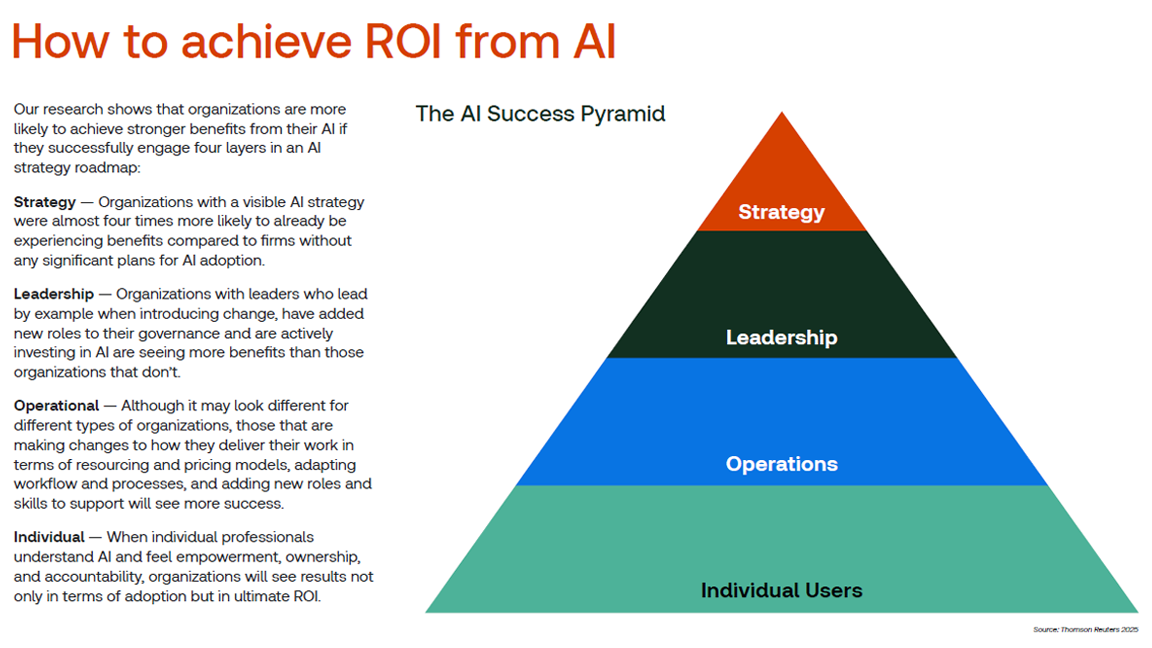
As AI becomes woven into every aspect of professional work, the opportunity for companies to differentiate themselves from their competitors by employing their unique AI-humanity approach can become a strategic advantage. While the efficiency gains and productivity promise of AI are real, those organizations implementing AI still need to leverage the irreplaceable value of human connection, cognitive growth, and meaningful work to maximize AI performance and ROI.

Follow us on social

Have questions?

Get in touch with one of our solutions experts....
成人VR视频 Institute logo

Featured Event

Table of
Contents
H2
H3
H4
H5
H6
February 20, 2026
The human side of AI: The growing risks of ubiquitous use of AI on talent
Excessive and unchecked use of AI in the workplace risks eroding human connection, cognitive skills, and employee well-being, requiring that organizations adopt a balanced, human-centered approach to AI integration.
8 mins read
February 20, 2026
Social
The human side of AI: The growing risks of ubiquitous use of AI on talent
Natalie Runyon
Content Strategist / Sustainability and Human Rights Crimes
成人VR视频 Institute
Headshot of Natalie Runyon
Agentic AI
AI & Future Technologies
Corporate Talent
Tax, Talent & Culture
Tech adoption
Technology training
Innovation and technology
Corporate professionals
Premortem: Your 2028 agentic AI pilot program failed
The AI adoption board game: Why law firm leaders can't afford to play it safe
The 2030 legal department: 5 ways AI will transform how in-house teams work